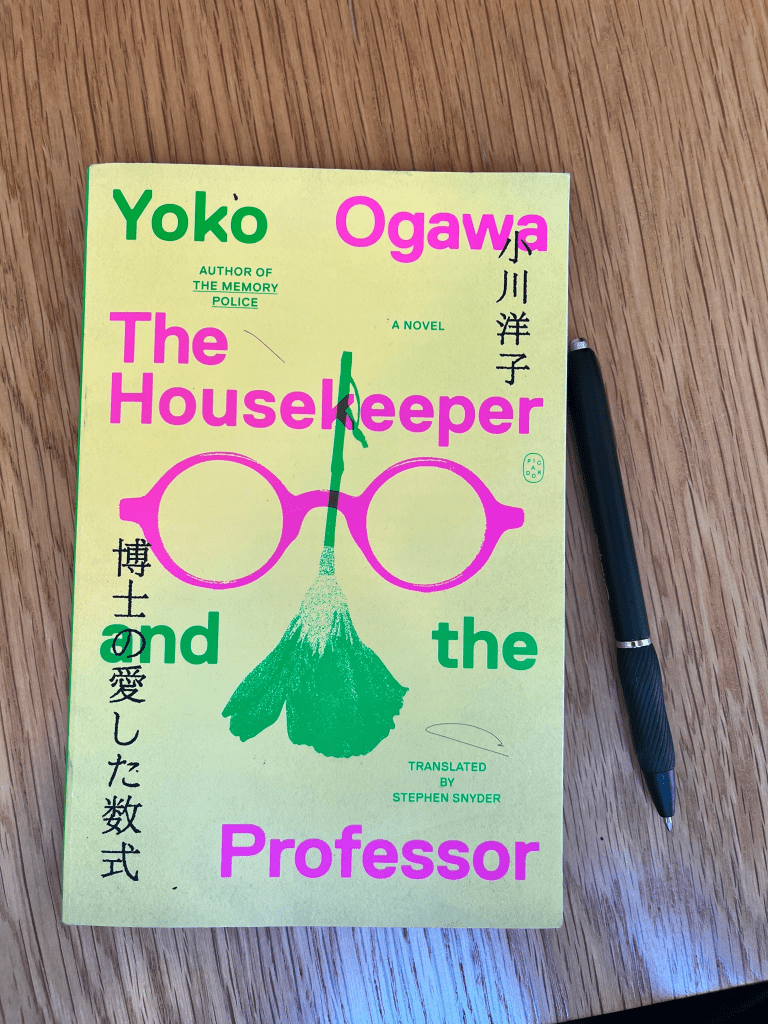
I recently wrote about how I was given a book by a stranger in a coffee shop. I sped read through the other novel I was reading in order to get to the new one— titled The Housekeeper and the Professor. Admittedly, the circumstances through which I received this new book makes me a very biased commentator, as I consumed the entire story through rose-colored convivial lenses. Nonetheless, I wanted to put down some brief, low-stakes reflections on this marvelous book. I highly recommend it to anyone keen for an easy, sweet story.
Abbreviated Description from Goodreads:
He is a brilliant math Professor with a peculiar problem–ever since a traumatic head injury, he has lived with only eighty minutes of short-term memory. She is an astute young Housekeeper, with a ten-year-old son, who is hired to care for him. The Housekeeper and the Professor is an enchanting story about what it means to live in the present, and about the curious equations that can create a family.
Thoughts
The prose of the novel is lovely and gentle. I have not read a lot of Japanese authors, but the ones I have read all seem to share this marvelous talent for penning austere language that still manages to radiate warmth—they prefer to show rather than beat you over the head with complex tellings. In fact, it’s not just the language that’s austere but the characters too. There are no unbelievable personalities, no major conflicts, and no hyped-up stakes. What the book “lacks” in flash it makes up for with depth. Although mathematics is the thread that runs through the book, the author intentionally takes this seemingly abstract, cold, and disenchanting science and turns it into a language for connection.
The character of the titular professor is as carefully crafted a protagonist as could possibly be constructed and was the standout attribute for me, personally. There were so many instances of characteristics, interactions, or compliments about him that reminded me of the various kindnesses, compassions, and generosities that have affected my own life. Whether it was the endless compliments he showered on the young housekeeper’s son, his child-like wonder at the mysteries of the universe, or the way that he made people feel smart in his presence (despite having his own staggering intellect), I found myself so yearning to want to be like the professor. His disability was inconsequential, at least in the ways that mattered in the eternal sense. Time and chance had placed him and the right people together—a funny concept considering the fact he was the victim of a terrible accident which cost him greatly. But that is the very essence of this book—an inquiry and appreciation into the strange unsolvable problems with answers written only “in God’s notebook.”
Quotes
Here are some random quotes I pulled that show the quality of writing and some of the heart-warming sentiments:
“Solving a problem for which you know there’s an answer is like climbing a mountain with a guide, along a trail someone else has laid.”
“”I think I’m a little smarter when I’m in the Professor’s office,” Root told me.”
The image I have of my father is that of a statue in a museum. No matter how close I come to him, I can’t get his attention, he continues to stare off into the distance without looking down, and he never reaches out his hand to me.
A thin sliver of moon hung above the row of sycamores glowing under the street lamps. A pleasant breeze was blowing, our stomachs were full, and Root’s hand would heal. I felt a great sense of contentment. My footsteps fell in with the PRofessor’s, and Root’s tennis shoes swung back and forth in time.
I could not begin to understand this never-ending number. It seemed as chaotic and random as a line of marching ants or a baby’s alphabet blocks, and yet it obeyed its own inner sort of logic.
Anyways— the book is an absolute winner. You should read it. Be prepared to smile, to tear up a little, and to have your heart expanded. With any luck, you’ll learn a little bit about numbers too.
 Bradley's Website
Leave a comment