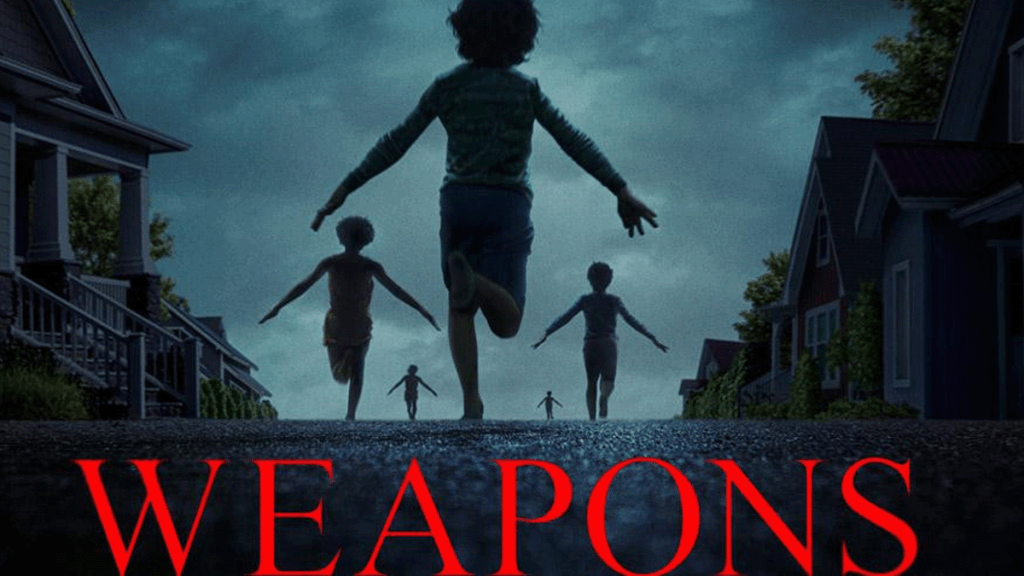
Monday evening, I was fortunate enough to catch a showing of Weapons, the sophomore film from director and writer Zach Cregger. The movie did not disappoint; Weapons is terrifying, hilarious, original, and utterly involving. The final fifteen minutes might be the best cinema we have gotten in 2025, so unless you have an aversion to horror flicks (which is very understandable), then this movie is an easy recommendation. Do not miss out!
That being said, if you plan on seeing the film and have not done so, then I recommend you save this webpage and revisit later.
There are MASSIVE spoilers ahead. You have been warned!
Synopsis
The plot of the film is very straightforward— at precisely 2:17 AM, seventeen separate children go missing after running out of their homes and into the dead of night. All of the children belonged to the same elementary school class and the only child to not go missing is a soft-spoken youngling named Alex. The storyline follows various characters in the style of the film Magnolia, mixed with some flavors from Prisoners, The ‘Burbs, and Hereditary. The big reveal is that Alex’s aunt Gladys is responsible for the missing children, as well as for the increasingly violent deaths occurring in the community.
Gladys is an old-school, dark magic witch who feeds off the life force of others in order to ward off the effects of her own terminal illness. She possesses Alex’s parents and threatens to have them kill Alex unless he obeys her. She eventually promises to leave town if he is willing to collect at least one object from each of his classmates’ houses, which she then uses for the spell that summons all the children to her basement at 2:17am.
The children are eventually discovered in the basement by the class’ elementary teacher, as well as one of the distraught fathers. The ensuing chaos provides an opportunity for Alex—who is being chased by his demonically murderous parents— to alter Gladys’ spell and make her a target of her own hex. Still under the effects of the spell but redirected, the kidnapped children pursue the witch through the neighborhood in a scene reminiscent to the ending of Ferris Bueller and, quite literally, tear her limb from limb.
Just A Good Movie
The thematic richness of Weapons makes it an easy target for think pieces and criticisms. There is probably something for everybody in this film: a wrestle with grief, the violent nature of reality, the trauma of collective loss, sexual abuse, or a potential indictment on gun culture in America. But, anyone looking for those themes to be totally consummated by the credit roll will likely be disappointed. Cregger has made it clear that he didn’t have a political stance or specific viewpoint in mind when he made the film; it is wholly a child of his subconscious. And, for what it’s worth, the film is actually better because of this. It doesn’t require the highbrow intellectualizing that A24 has made so popular. It’s just a really good film with well-written scenes, great casting, and a novel premise.
Genre and Homage
Firstly, I think the film made some unique contributions to the genre that are going to truly stand the test of time. The way that children run out of their houses—arms stretched straight and held behind them— is so unbelievably eerie. It’s an indelible image and I can already see swaths of New Yorkers running down streets on Halloween with their arms in airplane mode to spook the neighbors. Similarly, the way that doors move in the film is so consistently unsettling. I had never considered that there is a natural arc, rate of acceleration, and pace to the way that people swing doors; so when that familiar movement is extended into a very non-familiar movement, every audience member was groaning with anxiety. It’s such a testament to a director’s ability when they can transform mundane actions or objects into artifacts of absolute dread like Cregger did, so I think it deserves its flowers.
Also, the film had an homage to Stanley Kubrick’s The Shining which was so incredibly well done. The scene where Alex’s demonically possessed parents are tearing the house apart in order to beat their son to death is an automatic callback to Jack Torrance ripping through the Overlook Hotel in search of darling Danny. Cregger leans into this entirely and manages to recreate the iconic shot of a parent’s maniacal face pushing through the broken boards of a door, demanding the blood of their firstborn. It is a perfect homage, but also a great example of a student of the discipline using the symbols of his craft to elevate his art. I saw it, recognized it, and felt the weight of the moment even more for it.
A Random Thought and Quote From Dickens
Indeed, I was not expecting to cry in a horror film, but the scenes where Alex was going to the grocery store and spoon-feeding soup to nineteen captives in his home, including the classmates who relentlessly bullied him, had me on the verge of tears. He is never once put under a spell by the witch, but is left to experience the raw horrors of reality fully sober. In fact, Gladys controls him through a much older —and perhaps more salient— form of manipulation: intimidation. It brought to mind a passage from Great Expectations which I have always wanted to explore more fully:
I have often thought that few people know what secrecy there is in the young, under terror. No matter how unreasonable the terror, so that it be terror. I was in a mortal terror of the young man who wanted my heart and liver; I was in mortal terror of my interlocutor with the ironed leg; I was in mortal terror of myself, from whom an awful promise had been extracted; I had no hope of deliverance through my all-powerful sister, who repulsed me at every turn; I am afraid to think of what I might have done, on requirement, in the secrecy of my terror.
I have felt almost everything in my adult years: yearning, grief, hysteria, rage, lust, elation, euphoria, relief, transcendence, doom, anxiety, boredom; but I have never felt the abject terror that I was able to feel as a youth. This is fear in its rawest form, where reality and imagination mingle with hopeful, harmless innocence. As adults, we acknowledge that fear can paralyze, which we often experience as a robbery of our power and agency. “I felt so weak,” people say. But I wonder whether children, who do not have a credible history of powerfulness, might experience terror as something else entirely. You cannot feel your agency and strength desert you if you are not in touch with them in the first place. In Dickens’ book, as well as in Weapons, the result of child-like terror was secrecy, extreme isolation, and independence; the folding in of what should be an expansive and liberated imagination. It was the same for child-like Adam in the Jewish Torah, no?
Admittedly, I am not sure how this concept is applicable to my life, or if it’s even an coherent thought. But in an age where anxiety gets a lot of airtime, I am not sure we are as familiar with what it looks like for someone to be living in fear. There are many little Alexes and grown Alexes wandering the earth, languishing in isolation and terror. Although the movie is about seventeen children who went missing, I can’t help but shake the feeling that Alex, the lone survivor, is the one I should be looking for.
 Bradley's Website
Leave a comment